






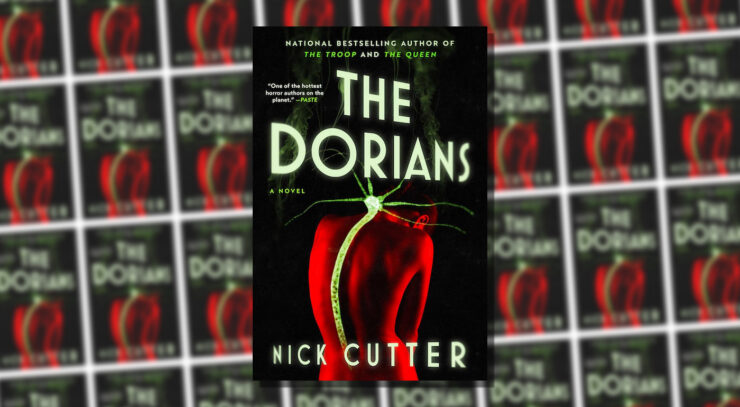
There’s a reason why two of Jordan Peele’s films have the titles Get Out and Nope, and why Edgar Wright filmed a parody trailer for Grindhouse called Don’t: Many horror stories involve people putting themselves in physical danger. A lot of horror involves a give-and-take between risk and safety, and puts readers and viewers in the awkward position of watching characters they can’t shout something at (“Leave that door closed!” or “You shouldn’t touch that!” are two examples) make questionable decisions. Nick Cutter’s novel The Dorians takes a slightly different approach. When we first encounter many of its central characters, they have a much more ambivalent relationship to their continuing existence. It’s one of a few ways in which Cutter’s novel eludes some expected narrative beats, even as it embraces some other, more familiar tropes.
There’s a good reason for why genre-savvy writers like Peele and Wright have opted for the titles mentioned above. A character desperately trying to stay alive as a monster or killer pursues them is dramatically satisfying; a character indifferent about whether or not they get eaten is not. Which isn’t to say that there aren’t ways to work around this: One of the most interesting aspects of Caroline Bicks’s study of Stephen King’s fiction, Monsters in the Archives, explores the evolution of Pet Semetary’s line “Sometimes, dead is better.” King himself has found another way around this, as the denouement of his more recent Revival arrives at a truly terrifying place that has nothing to do with physical risk.
Most of the main characters here, however, begin in a place where they’ve already decided to die. The Dorians begins with Frank Doyle, a man in his 80s with congestive heart failure. Frank is about to be given a series of lethal injections as part of Canada’s Medical Assistance in Dying program when a woman he has never met before arrives and offers him an alternative. Cutter doesn’t quite explain what she has offered, though he does hint that things will soon “go hinky.” (This turns out to be an understatement.) Not long after, he meets Teddy, a man with Parkinson’s who accepted a similar offer. And it’s off to a remote island with both of them, where they meet several others, all in their 70s and 80s, who agreed to learn more.
[For clarity: Nick Cutter is the pseudonym that Craig Davidson uses for his horror writing. There’s no subterfuge involved here—I interviewed him about both sides of his work years ago—but I’ll be using “Cutter” here to refer to the author for the sake of simplicity.]
Frank and Teddy are two members of a larger group selected for research into a biological substance that could reduce their ages. Cutter is making use of some real-world science here: Researchers are, in fact, looking into how some species of jellyfish regenerate with an eye towards seeing if this can help humans live longer, healthier lives. In the world of The Dorians, that comes in the form of the Hydra, a combination of genetic material from jellyfish, coral, and fungi. It has shown promise in animal testing; now, the time has come for human subjects to enter the picture. From the description of this as a horror novel, you can probably guess that things do not go as planned, even as the Hydra goes about its work and undoes the effects of time on the research subjects.
In addition to the actual science discussed in this novel, Cutter acknowledges certain genre influences here. The title of The Dorians comes from a nickname used by the participants in this research program, borrowed from a certain Oscar Wilde novel about an unaging man and his mysterious portrait. Daniel Keyes’s Flowers for Algernon comes up as a cautionary tale a few times, with Frank and his peers wondering if it might be worse to be given a rejuvenated lifespan, then see it withdrawn. And Dr. Astrid Marsh, the brilliant geneticist who came up with the experiment itself, refers to lessons she learned from reading Mary Shelley’s Frankenstein. Left unsaid is the fact that Dr. Marsh appears to have missed the point of a novel also known as The Modern Prometheus.
That sets up one of the more interesting aspects of Cutter’s book: the idea that with age comes wisdom and caution, qualities that could come in handy when creating chimeric creatures that act in symbiosis with living subjects. Cutter doesn’t appear to be making an overly didactic “young bad, old good” argument, thankfully; there are several characters closer to Dr. Marsh in age who prefer a more cautious route, and some of the Dorians who find the allure of restored youth to be worth any price. Dr. Marsh instead represents a kind of perfect storm: the impetuousness of youth combined with the arrogance of any number of tech CEOs who confuse risk with virtue.
[The spoilers get a little more significant here.]
Buy the Book

The Dorians
Frankenstein comes up a few times over the course of the book, and the Hydra’s ability to effectively poach organs from other living beings—something an infected wolf does—echoes the notion of a composite life form. There’s also an element of vampirism to the way the symbiote behaves; when the hinkiness alluded to earlier reaches a Gothic fervor, the Hydra’s ability to drain the essences of others in order to survive comes into focus. It’s not pretty.
Strangely, the novel that I found myself thinking of while reading this, more than the other works of Cutter’s I’ve read, was Justin Cronin’s The Passage, another book in which sober research gradually gives way to a primal terror. In that book, Cronin used one of the boldest narrative time-jumps I’ve encountered, making me wonder if something else might be in store here. If nothing else, the “Anno Hydra” present at the beginning of many of the chapters does provide a sense of historical scope.
The scope of The Dorians is a familiar one to horror readers—a small group of people in an isolated location where something deeply sinister is beginning to happen—but throughout it, there are hints of a much wider world, from Dr. Marsh’s mysterious funders to the question of just how mobile the Hydra is on its own. There’s a potentially apocalyptic narrative lurking just beneath the surface of this chamber drama—an image that fits this disquieting novel perfectly.
The Dorians is published by Gallery Books.

I just borrowed this from the library yesterday!